Saturday, January 23, 2016

The Inclusive University

“The current segregated system of education is injurious to Ukraine as much talent and potential is being wasted by failing to provide capable students an opportunity to attend universities and other programs of higher education.”  Dr. Olga Krsek, Dean of the Department of Philology, Volodymyr Dahl East Ukrainian National University, Severdonetsk, Ukraine.

Those who are familiar with my work here, are aware that I have been spending the last five years trying to open the doors of educational institutions of all levels (from kindergartens to universities) to students with disabilities.  Recently, I wrote and submitted a formal proposal for the development of an inclusive education program at Ukrainian Catholic University in Lviv.  Dr. Ihor Kobel and his colleagues have a strong commitment of providing post-secondary education for students with disabilities, so I hope their efforts of making UCU an inclusive university are successful.

Most Americans are accustomed to studying, working and living side-by-side with individuals with disabilities.  The same is not true in Ukraine.  The idea of allowing students with special needs to attend classes with their peers without disabilities is a radical and revolutionary concept here.  The people of Ukraine aspire to be a modern, democratic European nation, so it is critical that significant and permanent reforms be made within the Ukrainian education system at all levels.  

In 2009, Ukraine took a step towards improving equality for individuals with disabilities by ratifying the United Nations Convention on the Rights of Persons with Disabilities (Interfax-Ukraine, 2011).  While this is clearly a positive development, the path toward improving educational and social opportunities for individuals with disabilities has been excruciatingly slow and labored.  The government of Ukraine is still very young, and the country continues to face many daunting challenges regarding the economy, the justice system, political system, the battle against corruption, and the ongoing war with Russia.  Consequently, development and implementation of special education laws protecting the rights of children with disabilities has been highly inconsistent (Weishaar & Weishaar, 2011), with the result that special education legislation in Ukraine has stalled.  Currently, while Ukrainian law states that all individuals with disabilities have a right to an education, in reality, the law does not protect equality in education for individuals with disabilities (Raver-Lampman & Kolchenko, 2007b), and, furthermore, laws that are on the books are not enforced, so in reality students with special educational needs are not guaranteed the same education provided to students without disabilities. 

In addition to inadequate and unenforced laws, teachers and the general public are frequently resistant to inclusive education (Bondar, 2004; Kolupayeva, 2004; Ivanyuk, 2007).  Indeed, Kolupayeva (2004) has suggested that many teachers may even be intentionally thwarting progress towards inclusion of students with disabilities.  When school teachers in Lviv were surveyed about their opinions of inclusion, only 6% said they supported inclusive education (Ivanyuk, 2007).  I have spoken in schools and universities throughout Ukraine, and while many Ukrainians are beginning to support inclusive education, I continue to encounter teachers and administrators who are strongly opposed to inclusive education at all levels of education, including post-secondary programs.  Continued opposition to inclusion has resulted in reform delays as educators face resistance to the implementation of inclusive education programs (Ivanyuk, 2007; Raver-Lampman & Kolchenko, 2007b).   

Consequently, the absence of effective special education law and active opposition to inclusion has resulted in a de-emphasis on equality for students with disabilities at all levels of education, leaving Ukraine highly dependent on an extensive network of special and residential schools for children with disabilities (Raver-Lampman & Kolchenko, 2007a; UNICEF, 2011).  Most children with disabilities do not go to school with their peers without disabilities, but rather attend segregated schools which are organized according to eight categories: deaf, hard-of-hearing, blind, partially sighted, cognitively challenged, learning-disabled and children with speech disorders (Zasenko, 2004; Ivanyuk, 2007).  Additionally, it is not uncommon for students with disabilities to be home schooled rather than attend a public school program (Weishaar & Weishaar, 2011), while many other students with disabilities are not educated at all (UNICEF, 2011).  During my travels throughout Ukraine, I have been told repeatedly of instances when students with disabilities have not been permitted to attend school, and most experienced Ukrainian educators will also be aware of the same situation.  Even students having just a physical disability and normal cognitive ability may not be permitted to attend classes in their local school or take secondary school exit exams following home schooling (Weishaar & Weishaar 2011), making admittance into post-secondary programs exceedingly difficult.

Sadly, the situation worsens as students with disabilities grow to adulthood.  Following graduation from high school, students without disabilities continue on to post-secondary programs, while adolescents with disabilities live at home with their parents and do not further their education, resulting in high unemployment.  Adults with disabilities have an extremely difficult time obtaining jobs.  According to Ukrainian law, 4% of workers hired by employers must have disabilities, but unfortunately, the law is not enforced, so employers usually either avoid hiring employees with special needs or hire those with only the mildest of disabilities (Raver-Lampman & Kolchenko, 2007a).  Young people with special educational needs face chronic unemployment and social isolation.  Without opportunities to work, they become perpetual wards of their parents and ultimately the State, because they are unable to support themselves and live independently.  Consequently, they do not become integrated, productive members of the community, and the resulting social isolation and dependence on public assistance comes at a very high cost, not just for individuals with disabilities, but also for society, which ultimately ends up paying a pension to individuals who remain at home and do not productively contribute to the community.  One way of ending this vicious cycle of poverty and dependence is by providing students with disabilities unfettered access to post-secondary education.

Given the current political and educational climate, it is critical for Ukrainian educators to be able to effectively justify why it is important to desegregate higher education programs in Ukraine.  Providing an inclusive education to students with disabilities achieves a number of significant goals, one of the most important of which is to develop students’ independence, thus ending the cycle of poverty and perpetual dependence.  Students with disabilities who are successful in higher education learn skills and earn academic degrees which help them secure employment following graduation (UNICEF, 2011; WHO & World Bank 2011).  Inclusion also gives students with special needs opportunities to learn and socialize with peers without disabilities, helping them develop valuable social skills (Ivanyuk, 2007).  It has also been observed that the motivation and academic learning of students with special educational needs improves when they are educated in an inclusive environment, leading to greater academic achievement (Ivanyuk, 2007; UNICEF, 2011), which culminates in improved feelings of self-worth (Ivanyuk, 2007). 

Inclusive education is beneficial to students without disabilities, as well.  For instance, they learn how to live and work cooperatively with students with special needs, and they develop acceptance of their peers, which encourages positive social interactions and successful integration within the wider community (Ivanyuk, 2007).  The changes are considerable, as students learn to be more open, while improving their relationships with their peers with disabilities.  Additionally, by working and studying with students with special needs, students without disabilities develop positive attitudes of their peers, leading to greater social cohesion (UNICEF, 2011).  Finally, inclusive education reduces stigmatization of individuals with disabilities as students learn tolerance and acceptance of individual differences and respect for diversity, which are important characteristics in democratic societies (UNICEF, 2011).

If Ukraine can successfully desegregate post-secondary education, the results will be significant.  Students with disabilities will complete higher education programs and become contributing members of society, rather than exist as wards of the State.  Our experiences in the U.S. demonstrate that students with special educational needs can succeed in higher education, and career options for these students are nearly limitless. 

While it is essential that Ukrainian universities begin the process of developing inclusive education programs, it is not enough to simply admit students with disabilities.  Placing students with disabilities in university classrooms may be considered a form of integration, but it is not inclusion (Ivanyuk, 2007). Inclusion is a philosophy and process that allows all students to participate in all academic and extra-curriculum programs (Ivanyuk, 2007; Krsek, 2012; UNICEF, 2011).  Furthermore, in order for individuals with disabilities to succeed in higher education, a university must develop critical support systems and services for these students.  Academic support services and classroom accommodations aim to provide deaf and hard of hearing students equal access to the same instructional content as their peers without disabilities (Cawthon, Schoffstall, Garberoglio, 2014), which provides students with special educational needs with full and unfettered access to the curriculum.  These supports and accommodations equalize educational opportunities for students with disabilities and facilitate their academic success.  It is critical to remember that success will not occur by merely placing students with special needs in university classes.  In cases where students with disabilities have been admitted to Ukrainian universities without being provided support, the consequences have been failure, which is then used as evidence against inclusive education.

Furthermore, if Ukrainian universities are going to be serious about educating students with special needs, faculty and administrators must espouse a sincere belief and a strong vision that students with special needs have the same academic potential and educational rights as all other students.  This entails a rejection of the stereotypical practice of limiting students with disabilities to manual vocational training programs and allow them to participate in the same academic programs as their peers.  Dr. Olga Krsek at V. Dahl EUNU constantly reminds other Ukrainian administrators and professors that the role of universities is to train students’ minds for a future of independence, not their hands.  It is also important to remember that opening the doors of higher education to individuals with disabilities is a basic human right (UNICEF, 2011).


Obviously, with any reform proposal there will always be detractors opposed to any change, individuals who will insist that inclusion in higher education is not possible.  But it is possible.  Other programs in Ukraine have succeeded in educating students with special needs, for example, Volodymyr Dahl East Ukrainian National University in Luhansk and National Dragomanov Pedagogical University in Kyiv. Will this be easy?  No, of course not.  In fact, it will be very difficult, but being difficult is not a valid excuse to avoid doing the right thing.  We must continue striving to make quality education accessible to all students in Ukraine.  There is a fundamental relationship between how a society treats all of its members and the success of democracy.  A society that systematically disenfranchises and excludes specific groups cannot claim to be truly democratic.  Democracy is a fragile system of government, and it becomes increasingly frail, if a society denies education and community participation to targeted groups who do not meet the social norm.  One very important way to facilitate the development of democracy is to foster acceptance of and equal opportunity to all individuals, and desegregating higher education can help accomplish this goal.  Ukraine has made progress, but we cannot stop now, for the future of the nation and its citizens depends on a shared vision of equal educational opportunities for all students. Individuals with disabilities can achieve their goals if given the opportunity, and they can become independent, successful, contributing members of society.  To continue denying students with disabilities access to higher education not only holds them back, but it holds Ukraine back as well. 

Sources


Benedict, K. M., Rivera, M. C., & Antia, S. D., (2015). Instruction in metacognitive strategies to increase deaf and hard-of-hearing students' reading comprehension. Journal of Deaf Studies and Deaf Education, 20(1), 1-15.

Bondar, V. (2004, May). Special education for disabled people in Ukraine: Innovation and experiments. Modern Trends of Special Education Development (Canada-Ukraine Experience) (pp. 99-106). Open University- University “Ukraine”: Kyiv, Ukraine- Edmonton, Canada.

Cawthon, S. W., Schoffstall, S. J., & Garberoglio, C. L. (2014) How Ready are Institutions
for Students who are Deaf or Hard of Hearing? Education Policy Analysis Archives, 22 (13).
http://dx.doi.org/10.14507/epaa.v22n13.2014.

Interfax-Ukraine. (July 6, 2011). Ukraine to bring its legislation in line with UN Convention on Rights of Persons with Disabilities. Retrieved November 10, 2015, from http://www.kyivpost.com/content/ukraine/ukraine-to-bring-its-legislation-in-line-with-un-c-108113.html

Ivanyuk, I. (2007). Status of inclusive education in Ukraine, Regional Preparatory Workshop on Inclusive Education Eastern and South Eastern Europe, United Nations Educational, Scientific and Cultural Organization (UNESCO). Retrieved from the Internet, November 8, 2015, http://www.ibe.unesco.org/fileadmin/user_upload/Inclusive_Education/Reports/sinaia_07/ukraine_inclusion_07.pdf

Kolupayeva, A., Trends in the integration of special education in Ukraine, Modern Trends of Special Education Development (Canada-Ukraine Experience). Open University-University “Ukraine”, Kyiv, Ukraine-Edmonton, Canada, 142-146, May 2004.

Krsek, O. (2012).  Inclusive education for university students with disabilities. Concept Paper: USAID, Regional Mission for Ukraine, Moldova and Belarus.

Raver, S., & Kolchenko, K. (2007). Inclusion of school-aged children with disabilities in Ukraine. Childhood Education, 83(6), 370-373.

Raver-Lampman, S. & Kolchenko, K. (2007). Comparison of perceptions of inclusion between university instructors and students with disabilities in Ukraine.  The Journal of the International Association of Special Education, 8(1), 43-53.
  
UNICEF, (2011). The Right of Children with Disabilities to Education: A Rights-Based Approach to Inclusive Education in the CEECIS Region. Geneva, Switzerland.

Weishaar, P. M., & Weishaar, M. K., (2011). Access to public school education for students with disabilities: United States and Ukraine. Interdisciplinary Approach, 1(2).

World Health Organization (WHO) and World Bank, (2011). World report on disability. Geneva, Switzerland.

Zasenko, V. (2004, May). Special education in Ukraine: Current conditions and the search for new
perspectives. Modern Trends of Special Education Development (Canada-Ukraine Experience) (pp.

121-126). Open University-University “Ukraine”: Kyiv, Ukraine- Edmonton, Canada.

Monday, January 26, 2015

The Effects of War

I rarely write about the war in Ukraine in these pages.  For one thing, it is a very depressing topic, and people here are so beaten down and discouraged that I don't like adding to the negative discussion and thoughts that daily dominate the news and mealtime table talk.  I want to focus on special education in Ukraine and the positive aspects of my work here. 


Unfortunately, one really cannot avoid the issue of the war with Russia and it's effect on education.  By now it should be evident to readers of this journal that Ukraine faces many challenges in the area of special education.  There are so many needs:  Children with disabilities do not receive appropriate educational services or are denied an education altogether.  Older students with disabilities are generally denied entrance into higher education programs or are permitted enroll in very limited and stereotypical vocational programs.  There is a belief among some educators that individuals who are blind or deaf are good at manual labor, such massage or auto repair, but little else (not everyone believes this, of course, but it's a pervasive attitude).  Students with disabilities fortunate enough to attend a higher education program are not always permitted the freedom of choosing a field of study that interests them.  Additionally, there are no university programs for educating special education teachers.  These are just a few examples facing students, families and educators.


Before the war, significant gains were made.  In Luhansk, a program at Volodymyr Dahl East Ukrainian National University was developed by Dr. Olga Krsek that allowed deaf and hard of hearing students to receive a genuine education and obtain the same degree level as students without disabilities.  Tragically, all of her efforts have been destroyed by the war in the Donbas, and the Russian leaders in Luhansk (and Donetsk) have no interest in providing education to students with disabilities.  Such an idea is incompatible with their outdated Soviet mindset.  During the period of the Soviet Union, which the Russian terrorists in the Donbas are trying to resurrect, Soviet society was viewed as a perfect model for the rest of the world to emulate.  Consequently, all individuals with disabilities were hidden away, because they were viewed as imperfect.  Sadly, all of our progress in Luhansk towards equalizing education for students with disabilities has been lost.

The war situation in Ukraine is worsening rapidly as Putin is becoming more aggressive and dangerous. Unless the West gets serious about stopping him, there is little hope for ending this terrible conflict, as Ukraine has limited financial and military resources. It is very depressing to watch the endless suffering of the Ukrainian people and being completely powerless to stop it. The war affects my work here in many negative ways. How we can provide services to children with disabilities when there is no funding? It is very difficult to reform education when all of the government’s focus, attention and resources are directed at the war in the east. Ukraine is a country fighting desperately to survive and under these difficult conditions, providing an education for students with disabilities and developing new special education programs has become a monumental challenge.

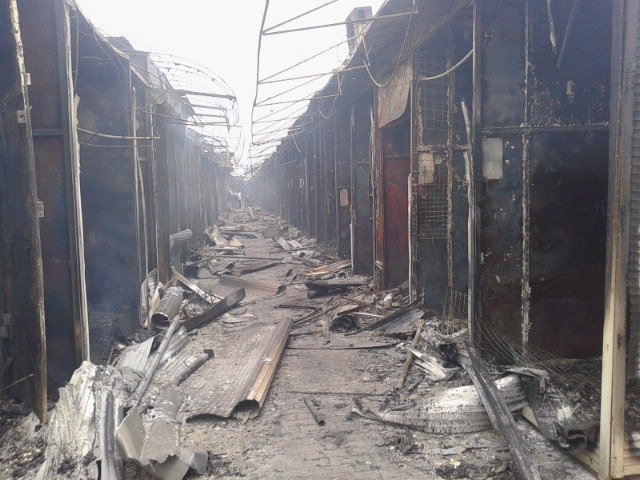
Here are some photos of damage in my former city of Luhansk, as a result of the fighting.


The Library in Luhansk. 
This breaks my heart.  
I still have my library card.
(Photographer unknown)


An apartment building in the Vatutin neighborhood  
damaged by shelling.  My building was located in this area.
(Photographer unknown)


The Central Market
This is one of the places where I used to shop in Luhansk.
(Photographer unknown)


The Central Market
(Photographer unknown)


The Central Market
(Photographer unknown)


The Central Market
(Photographer unknown)


The Central Market
(Photographer unknown)

Friday, January 23, 2015

The Challenges of Educating Ukrainian Children with Autism

I have a tireless and dedicated colleague who leads the only kindergarten for children with autism in the entire territory of the former USSR.  It is located in Kyiv and serves children ages 2 to 7.  In Ukraine, the situation for children, youth and adults with Autism Spectrum Disorders (ASD) is profoundly severe.  Intervention and educational programs for these children and youth are nearly non-existent throughout the various and far-flung republics of the former Soviet Union.  To make matters worse, as soon as a young Ukrainian with autism turns 18, he or she is automatically classified as having schizophrenia and is placed on psychotropic medications, which is entirely inappropriate and ineffective.  In Ukraine, autism is viewed as a mental illness and falls under the jurisdiction of the Ministry of Health, which is counterproductive, because autism is not a mental illness, but rather a developmental disability.  Medications may be used to treat severe symptoms in some individuals, but the most effective treatment is early intervention therapy from birth to age three. Indeed, therapy and behavioral interventions are the predominant and most effective ways of improving children’s development.   Additionally, children with ASD also benefit from educational interventions. 

The situation here is absolutely dire.  In Ukraine, children with ASD frequently are never properly identified or identified very late, which means the critical window of early childhood intervention is missed.  Obviously, early screening by trained pediatricians followed by a thorough evaluation is absolutely critical.  Tragically, most Ukrainian children with ASD never receive appropriate therapeutic and educational services.  Other than Ina Markovitch’s, school, which has a waiting list, parents have few options and nowhere to turn for help. The general attitude in society is to totally reject and ignore individuals with autism, and as a result parents of children with Autism Spectrum Disorders live in absolute shame.  Their children remain at home, hidden away by families too afraid or ashamed to take them out into public.  In Ukraine there is a profound stigma attached to having a child with a disability, any disability, but especially having a child with severe needs, particularly developmental disabilities such as ASD, cognitive disabilities or profound physical disabilities. 

I am a teacher of the deaf, so I have limited experience working with children with ASD, but because I am one of the few (or only?) American professors in special education in Ukraine, I am often asked to help address a wide range of difficult problems.   Currently, with the help of a medical colleague, I am trying to help Ina develop a program for teaching physicians how to screen young children for autism, so they can be properly evaluated (a another significant challenge here).  I would like to set up a conference where pediatricians and family practitioners receive some training on screening children for a range of disabilities.  A topic of significant importance to me professionally is Early Hearing Detection and Intervention (EDHI).  I would love to present a breakout session on this topic at the above mentioned medical conference, because early identification and intervention is crucial to effective language development of deaf and hard of hearing children.

The goal of the pediatrics conference would be the eventual widespread establishment of special education screening and evaluation programs, which would lead to effective early intervention and education for children with autism and other disabilities.   Secondly, I would like to see the development of higher education programs for training special education teachers.  Currently, Ukrainian teachers of children with disabilities receive no training.  The few individuals who do choose to work with children with special needs must learn as they go.  I also want oversight of Autism Spectrum Disorders moved from the Ministry of Health to the Ministry of Education.  That would have profound implications on how programs for children with ASD are viewed and managed.

Sunday, December 7, 2014

Recommended Reading

Most Americans know very little about Ukraine, and not until Russia's war against the Ukrainian people have they given the nation much thought or were even able to locate it quickly on a map, if at all.  This is not a criticism, but merely an observation of the consequence of American education. 
 
Since Russia has invaded, there has been no shortage of opinions about the crisis here.  Some Americans have become apologists for Kremlin aggression, while others maintain more hawkish sentiments.  Still, while at least vaguely aware of Ukraine, most Americans remain largely ignorant of the Ukrainian people and their history, culture and language.  They also have limited knowledge regarding the incredibly complex political and military climate, as well as its profound affect on world diplomacy and economics, which is why I recommend an extremely important book.  If you want to truly understand Ukraine and why the Ukrainian people are so determined to preserve their language, culture, and independence, please read Timothy Snyder's Bloodlands:  Europe Between Hitler and Stalin.
 
In some ways it is understandable when individuals lack certain knowledge of a country in which they no personal experience or direct education, but when a previously unknown nation suddenly takes center stage in world politics and diplomacy, people have a responsibility to learn as much as they can before formulating opinions and making statements. 
 
I rarely insist that individuals read a particular book.  This is one exception.  If you want to understand Ukraine, please, please, please read Bloodlands, and if you want to post comments at online blogs and media sites about the situation with Russian and Ukraine, then reading Snyder's immensely important work is absolutely critical.  And please ask your elected officials to read Bloodlands, for it will prove a valuable resource for them, as well.


Sunday, November 9, 2014

Inclusive Education

Classes at the university are going well.  My students are interested and engaged, which is not just helpful, but also refreshing.  I try to ask as many questions as possible and encourage them to express their ideas freely.  I want to avoid droning endlessly on.  I want to stimulate intellectual discussion, not discourage it.  On that note, I have found that all of my students are open to the concept of educational inclusion students with disabilities and most of them actively support it.  Recently, we have been discussing strategies and interventions to help students with disabilities successfully learn in general education classrooms.  As my one of my colleagues in Luhansk has often said, merely placing deaf students in university classrooms is not enough, we must take appropriate measures to make certain they will succeed.  They can succeed, but professors and administrators must take the necessary steps to provide the students with appropriate academic supports and provide complete access to the curriculum.  The same is true of students in elementary and high schools.

Looking at their essays, I am pleased that my students have been thoughtfully articulating strategies for successfully integrating students into general education classrooms and facilitating their learning.  This is just a first step, however.  As inclusive education is rarely practiced in Ukraine, implementing inclusion will be a significant challenge, especially since so many teachers, parents and administrators have not embraced the concept, but if Ukraine is to be a truly open, accepting and democratic society, it must provide equal access to education for all students.  This is critical, as inclusive education is a necessary prerequisite for a fully inclusive society.

Before they were buried in Gorky Park

On a lovely day after work, one of my friends here in Vinnytsia was walking with me from the university, and she was showing me various historical sites in the city.  As we were leaving Gorky Park, where she told me the story of a massacre and graves of Stalin's victims buried there, she whispered, "Now I will show a police station where if you went in, you never came out."  She was referring to the headquarters of the People's Commissariat for Internal Affairs or NKVD (Народный комиссариат внутренних дел - НКВД).  The NKVD was the Stalin's secret police organization and was responsible for mass murders throughout the Soviet Union.  The Vinnytsia branch of the NKVD was particularly ruthless and killed literally thousands of innocent civilians.  These victims were buried in what is now Gorky Park and numerous other graves.  There were at least 87 NKVD mass graves in and around Vinnytsia.

As we were approaching the building, she ever so discretely gestured toward it, and whispered, There it is."  She was so discrete I needed clarification and pointed towards it asking, "Is that the building?"

She immediately, though gently, reprimanded me with fear in her voice admonishing, "Don't point! The police might be watching."  Having come of age under Stalin and his repressive system, she still harbors many of the same fears that gripped her when she was living under the Soviet system.  Her fears and behaviors are reflexive, but no longer really necessary.  Today, the old NKVD building is still a police station, but it no longer houses the feared secret police organization that murdered millions of people.

Former NKVD Headquarters


Wednesday, October 29, 2014

A word regarding the title of my blog

Some readers may be wondering why the title of my blog is "My Fulbright Scholarship at EUNU - Luhansk, Ukraine" when I am no longer at V. Dahl East Ukrainian National University.

I thought about changing the title of my blog to reflect my current location in Vinnytsia, but I ultimately decided keep the current title, because my work here is a continuation of my work in Luhansk.  I would not be in Vinnytsia today, if it had not been for Olga's ambitious and important project at V. Dahl EUNU.

Secondly, I am leaving title intact as a tribute to the wonderful students and professors in Luhansk.  Sadly, V. Dahl EUNU no longer exists.  The war put an end to that great university, and this is my small way of honoring the hard work and incredible successes of Olga and her colleagues who made it possible for deaf and hard of hearing students to attend the university for the very first time in 2011.  I don't want the university or their pioneering work to be forgotten.